

Residency position in diagnostic imaging
Position from July 15, 2026, to July 14, 2029
The residency
The WCVM is accepting applications for a combined three-year veterinary medical imaging residency and graduate program (project-based Master of Science program). Applicants must have a DVM (or equivalent) degree and a one-year rotating internship. Formal experience in medical imaging is preferred.
This individual is expected to have strong independent learning skills and be highly motivated. The clinical aspect of this program will provide residents with a diverse caseload to develop strong interpretation and technical skills and will support preparation for the certifying examination.
The academic portion of the program will provide opportunities for research experience and formal preparation for the qualifying examination as well as manuscript preparation and presentation. Ultimately, our goal is to prepare and support talented residents in passing the ACVR examinations and completing a non-thesis MSc program.
About the WCVM and VMC
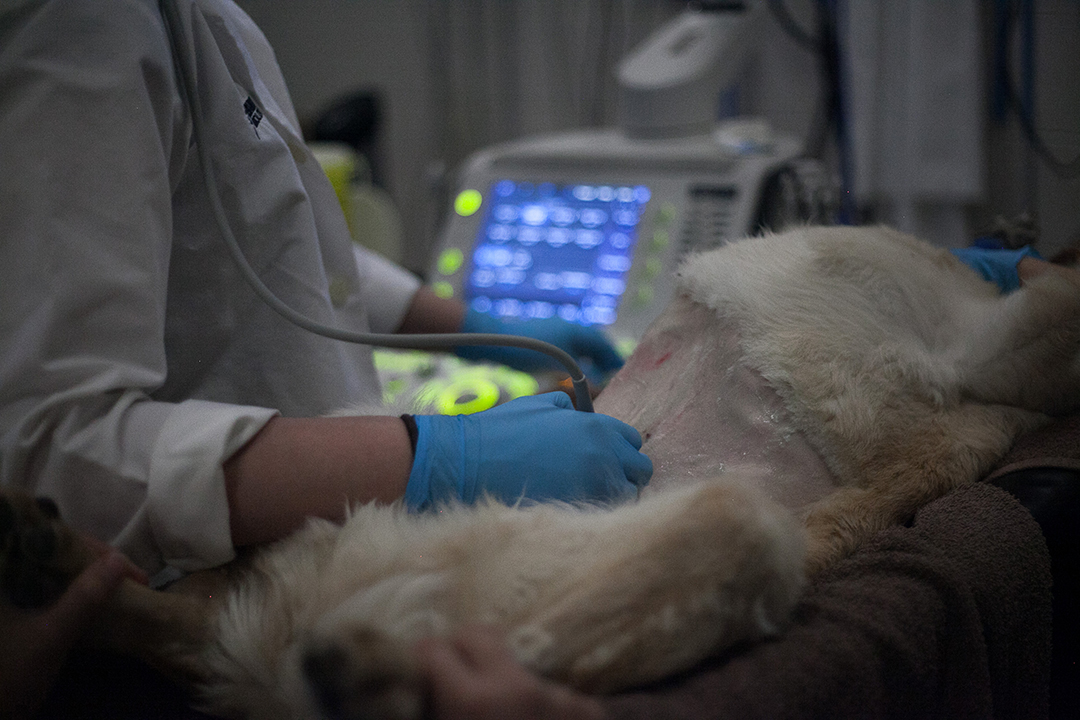
The Veterinary Medical Centre (VMC) at the WCVM has a growing medical imaging caseload in small, large and exotic/wildlife patients. The advanced imaging equipment include the following:
- 80-slice Toshiba Aquilion Prime CT scanner
- GE Discovery MI PET/CT scanner
- Millenium MPR/MPS gamma camera with Genie AcQ software
- Philips BV Pulsera C-arm fluoroscope
- Toshiba Aplio 300 ultrasound machines with multiple specialized probes
- Canon Plate DR systems for large and small animal radiography
MRI technology includes in-house Siemens 3.0 Tesla MRI for small animals and a standing equine MRI in the Ryan/Dubé Equine Performance Centre. The McKesson Horizon Medical Imaging PACS provides access throughout the VMC for consultation, diagnosis and teaching on clinical and research cases. The college offers specialty services in anesthesiology, medical oncology, radiation oncology, small and large animal surgery, small and large animal internal medicine, dentistry, dermatology, ophthalmology, exotics, and nutrition.
In addition to their clinical responsibilities, the resident will be expected to provide assistance in the teaching and supervision of final-year veterinary students in the clinic and daily teaching rounds. The resident will also participate in labs, seminars and other teaching experiences. On-call duties are generally one in every three weeks, but during certain times of the year, frequency may increase to one in every two weeks. Residents are also permitted and encouraged to participate in pathology seminars, weekly lecture series and special lectures offered throughout the year. Each resident will be required to present one seminar to an audience of faculty, staff, and students.
Residents are required to enrol in the University of Saskatchewan (USask) College of Graduate and Postdoctoral Studies and register for a MSc degree program. This is a non-thesis program including coursework and a research project. Graduate level courses are available through the Department of Small Animal Clinical Sciences. Graduate courses available to our residents include Radiographic and Cross-Sectional Anatomy, Ultrasound and Radiation Physics and CT/MRI Radiation Biology and Protection.
The WCVM has an active research community with opportunities for collaboration with various colleges on campus. USask is home to the Canadian Light Source where there are numerous opportunities for research in exciting new synchrotron imaging techniques. The city of Saskatoon, Sask., is a vibrant, growing city with excellent cultural opportunities to enjoy life outside of the hospital.
Application process
Residency stipend (Canadian funds): C$40,000 per year
Tuition and Student Fees: residents will be enrolled in the USask College of Graduate and Postdoctoral Studies, and as such, they must meet their requirements for entry and are responsible for the associated tuition and student fees. See website: http://www.usask.ca/cgsr/ for more details.
Foreign applicants must also check the USask requirements for English proficiency, and, if applicable, original proof of English Proficiency is also required as part of the application package. For further information, please go to: http://grad.usask.ca/admissions/admission-requirements.php
Successful candidates will also need to obtain licensure with the Saskatchewan Veterinary Medical Association (www.svma.sk.ca).
Applications accepted until January 5, 2026, or until a suitable person is identified.
Interested individuals should submit:
- a letter of intent
- current CV
- unofficial copies of transcripts from ALL post-secondary institutions attended
- proof of English proficiency (if required)
As well, please request three letters of reference.
Please send all documents to:
Charla Penner (charla.penner@usask.ca)
Department of Small Animal Clinical Sciences
Western College of Veterinary Medicine, University of Saskatchewan