

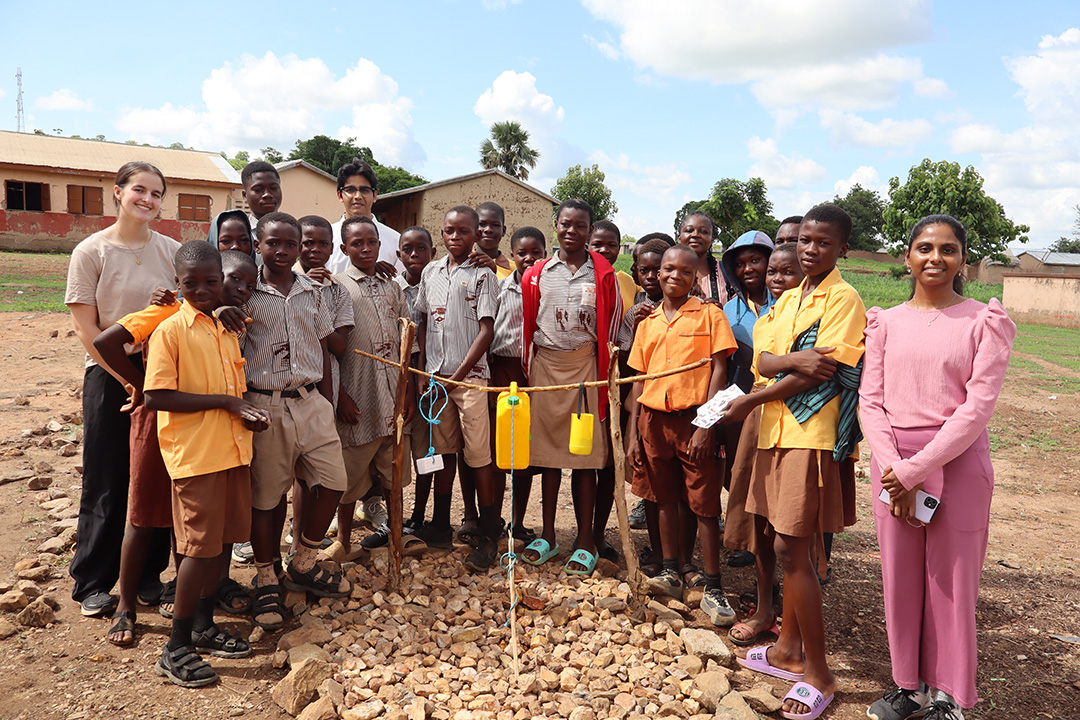
One Health in action: partnership for a prosperous future
As Canada marks International Development Week (Feb. 1-7), the One Health Community Partnership (OHCP) project is highlighting how education, leadership and innovation have strengthened One Health knowledge and resilience for people, animals and the environment across project sites in Uganda and Ghana in 2025.
Working hand in hand with local partners, University of Saskatchewan (USask) students have helped catalyze change for people, animals and the environment. Through the One Health Community Partnerships, they have led immersive lessons, supported emerging leaders and transformed classrooms into hubs of resilience and possibility.
A One Health approach
In 2025 the One Health Community Partnership (OHCP) project, which is based at the Western College of Veterinary Medicine (WCVM) on the USask campus, continued to advance its mission to strengthen One Health knowledge and resilience where human, animal and environmental health intersect.
Supported by Global Affairs Canada and USask, the project engaged schools and communities in Uganda’s Isingiro’s and Ghana’s Nabdam District. In these regions, OHCP student volunteers from USask played a central role in bringing the project’s initiatives to life.
The OHCP is aligned with the United Nations Sustainable Development Goals (SDGs 1-6,10,13,15 and 17) and addresses priorities related to ending poverty, zero hunger, good health and well-being, quality education, gender equality, clean water and sanitation, reduced inequalities, climate action, life on land, and partnerships. These priorities are combined with Global Affairs Canada’s commitment to gender equality and the power of partnership to achieve lasting change. OHCP emphasizes interactive education, community-driven engagement, and mainstreaming of girl’s leadership and voice throughout its work.
The One Health approach has gained urgency amid climate change, globalization and the increasing threat of emerging diseases. In many low-resource settings, health challenges are compounded by limited access of women and girls to information, education and decision-making power. In response, OHCP’s work in 2025 emphasized gender-transformative capacity building — particularly empowering women and girls in areas at high-risk for zoonotic and environmental health threats. Through education, participatory learning and locally adapted initiatives, the project strengthened knowledge and practical skills while nurturing community leadership.
In collaboration with the local project team, USask student volunteers developed educational materials and thoughtfully adapted them to reflect local languages, cultural contexts and school curricula. Foundational One Health concepts were introduced in schools by OHCP volunteers working closely with students and teachers.
Bringing One Health to schools
From May to July 2025, USask student volunteers collaborated with local educators to teach children (ages 10 to 17 years) across two countries. Together, they co-facilitated three interactive learning modules that were designed to make complex health interconnections tangible and relevant, while ensuring age-appropriate, culturally grounded delivery and inclusive participation.
- Module 1 introduced One Health basics — how water quality, hygiene behaviours, animal health and environmental conditions shape well-being across people, animals and ecosystems (SDG 3, SDG 6, SDG 15).
- Module 2 focused on water, sanitation and hygiene (WASH) — including respectful, fact-based discussions about menstrual health and hygiene. Boys were engaged as supportive allies to foster safe, inclusive school environments to their female classmates (SDG 5, SDG 6).
- Module 3 added basic first aid, where students learned everyday skills such as wound care and emergency response techniques to build confidence and preparedness (SDG 3).
Observations, quick pre- and post-session checks, and student feedback pointed to meaningful gains in understanding and shifts in daily practices related to hand hygiene, safe water use and general health awareness.
Student leadership and gender equality in action
To sustain momentum, USask student volunteers helped establish One Health Clubs in schools, creating inclusive spaces for students to practise what they learned, take on leadership roles and advocate for school- and community-level improvements. All clubs were led or co-led by girls, reflecting OHCP’s commitment to gender equality and to creating pathways for young women as community change agents (SDG 4, 5).
Meeting monthly with teachers and school administrators, and with ideas grounded in local priorities, student club leaders drove initiatives such as sanitation improvements, peer-led awareness campaigns, and environmental projects such as tree planting for soil conservation to maintaining clean animal enclosures to reduce disease risk (SDG 13). These initial activities, initiated through discussions with USask student volunteers, are now being supported by local project staff to encourage continued implementation and to build momentum (SDGs 3, 6,13,15).
By creating leadership opportunities linked directly to school and community health, the initiative not only built practical skills but also strengthened students’ confidence and agency — especially among girls who may otherwise have limited access to leadership roles.
Students expressed excitement at realizing they could make meaningful contributions using resources already available to them. Many shared what they learned with family members, further extending the impact of the program into the wider community. The locally grounded, participatory education helps to build meaningful health literacy and resilience even in resource-constrained environments.
What we learned
The following points highlight the key learnings for the OHCP partners.
- Intentional relationship building: investing time to build trust with schools, educators and community partners laid the foundation for participation, local ownership and sustained engagement (SDG 17).
- Developmentally and contextually appropriate education: focusing on upper primary and early secondary students enabled richer discussions; co-teaching alongside local educators strengthened comprehension and continuity (SDG 17), underlining the importance local teachers play in translation, reinforcing key concepts and embedding One Health principles in existing learning environments.
- Make it experiential and visual: interactive demonstrations, storytelling and hands-on problem-solving helped students translate abstract One Health concepts into practical understanding, knowledge retention and encouraged application beyond the classroom — particularly in hygiene practices and disease prevention (SDG 3, SDG 6).
- Adaptive delivery: language barriers, changing schedules and varied facilitator experience underscored the importance of flexible delivery and ongoing support without losing sight of learning outcomes and inclusion.
Looking ahead
As the project moves forward, these lessons will guide scalable, gender-responsive and community-led One Health programming, providing a strong foundation for continued learning, adaptation and impact in future project years.
OHCP’s 2025 experience demonstrates that when learning is locally grounded, gender-responsive and co-created with partners, it can catalyze lasting positive change, which reflects the spirit of International Development Week 2026: Prosperity through Partnership, and underscores the shared promise of a healthier, more equitable future for all.
Sustainable Development Goals (SDGs): alignment
The OHCP project activities, including those highlighted above, directly advance:
- SDG1 (no poverty)
- SDG 2 (no hunger)
- SDG 3 (good health and well-being)
- SDG 4 (quality education)
- SDG 5 (gender equality)
- SDG 6 (clean water and sanitation)
- SDG 13 (climate action)
- SDG 17 (partnerships for the goals)
Together we will support and inspire students to succeed. We invite you to join by supporting current and future students' needs at USask.