

One Health in action: July 2026 newsletter
Newsletter of the One Health Community Partnerships (OHCP) | First Edition | July 2026
Executive Summary
By Dr. Claire Card, Professor, Western College of Veterinary Medicine | Project Lead and Governance Team Member — Animal Health Lead
Click here to read the July 2026 newsletter highlighting the work and achievements of the One Health Community Partnerships Project team.
This newsletter is an update about the One Health Community Partnerships project funded by Global Affairs Canada. The project focuses on vulnerable women and girls in sub-Saharan Africa who face some of the most discriminatory laws and live in rural places with extensive environmental challenges and are disproportionately exposed to zoonoses. The women and girls in these communities face complex poverty with deeply interconnected challenges.
Our project has three focus countries: Uganda, Ghana and Ethiopia. Each country has rural women and girls heavily burdened with poverty and domestic chores. Additionally, all communities face water stress and climate instability, which has made rain-fed agriculture more precarious. The sudden loss of the USAID funding that supported: access to HIV medication, diagnostic tests, and clinics was being felt. In Uganda a small Ebola outbreak, in Ethiopia recurrent drought and water scarcity that continue to decrease household income and nutrition while increasing women’s workload, and in Ghana illegal gold mining causing massive environmental damage and threatening water supplies, are ongoing challenges.
Our One Health gender transformative approach is anchored in four main project pillars: human health, domestic animal health, environmental health, and pandemic preparedness. Due to the degree of connectedness between the four pillars, we address all pillars collectively.
To accomplish our goals in Year 1, we went to work interviewing, hiring staff, putting together the team, and visiting the project sites. We were invited to talk to local experts and relevant actors across the pillars. We developed: student safety, recruitment, and orientation materials; a project implementation plan; monitoring evaluation and learning plan; and gender assessment.
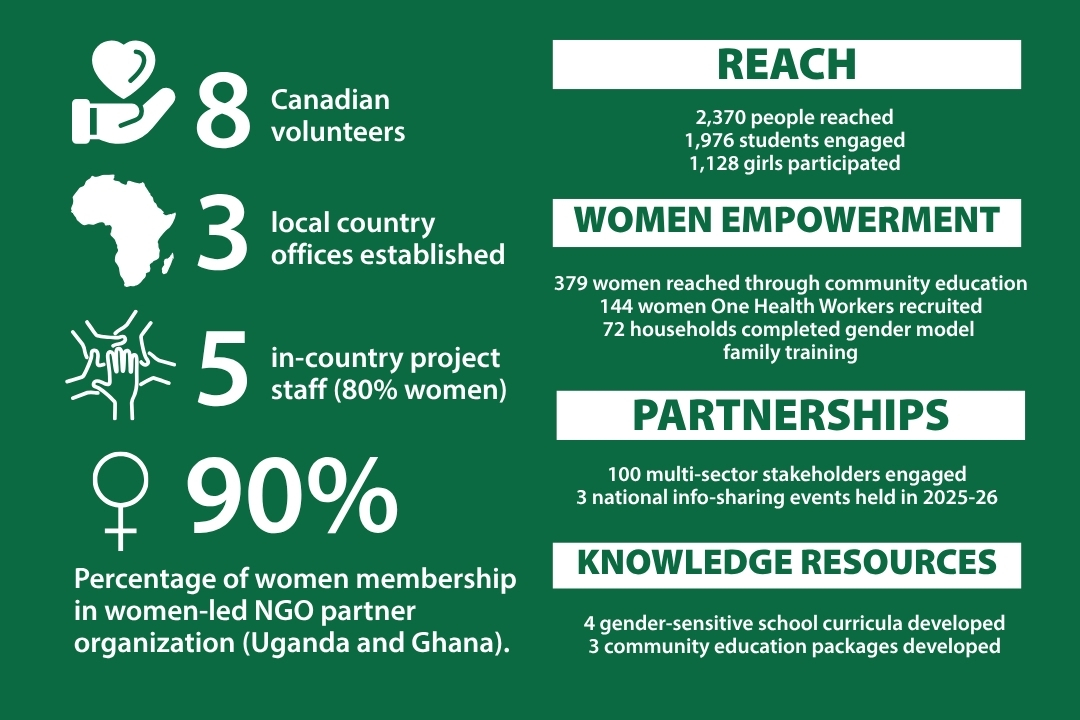
In Years 2 to 4, we recruited students to deepen community relations with women’s groups and schools; WaSH mapped communities; devised tools to obtain baseline data and analysis; and trained our new staff in the 3 countries. In Year 3-4 we began school visits teaching students about One Health concepts; worked on writing, adopting and translating W1HW curriculum; and began Gender Model Family (GMF) sessions which aim for creating changemakers to upend deeply ingrained cultural norms and practices. In a GMF household responsibilities and decision making is shared so everyone in the family does better. We have also identified and started training of Women One Health Workers (W1HWs). The W1HWs are part of a 3-person team that provides community services in: human health (Village Health Team Worker), animal health (Community Animal Health Worker – Paravets) or environmental health (Water/Sanitation and Hygiene - WaSH) work. As the W1HWs were likely to be first responders in a pandemic, we included training on pandemic prediction, prevention, identification, and response.
We are thankful for the continued work in Uganda with the non-governmental agency Western Hope for Future Initiative (WHFFI) that arose from the community-based organization called Veterinarians Without Borders Paravet Association. The Paravet Association’s first members were trained by volunteer veterinarian Dr. Kent Weir, from Lloydminster, Sask., in 2008, with financial support from Veterinarians Without Borders (VWB). We have been proud to be their partner for so many years in the Isingiro District. In Uganda, the country project manager is Annet Busingye who is based in the office in Kaberere with her staff.
We have partnered in Ethiopia with the Brooke Hospital for Animals, a UK charity which has a branch in Ethiopia. In Ethiopia our project is implemented in the Halaba Zone. Our country project manager is Tigist Gebrehiwot, who will be based in Halaba Kulito Town with her staff. In Ghana, our partner organization is Apex Women in Poultry Value Chain (WIPVaC-Apex Ghana). Our project in Ghana is implemented in the Nabdam District, and our country project manager is Severa Soyiri, who is based in Bolgatanga with her staff.
As OHCP begins our fourth year, our work in Ghana, Uganda and Ethiopia continues to grow. We were proud to see women, girls and youth step forward as active leaders—identifying challenges, sharing insights, and co-creating solutions that reflect the One Health-related realities of their daily lives. Whether the perspectives came from classrooms, women’s groups, and village centers, their voices and lived experiences have guided the direction of our work, reminding us that partnership-driven development remains our most powerful tool.
Across all three countries, this year has demonstrated what becomes possible when communities, volunteers, and local organizations work hand-in-hand. At the heart of the OHCP Project is the belief that resilient communities are gender equitable. Empowerment of women and girls creates communities that are healthier, safer, and more prosperous. This newsletter celebrates that momentum.
Most importantly, we thank the women, men, students, teachers, Women One Health Workers, and Gender Model Families who continue to lead change in their communities. Your commitment, dedication, and leadership are the foundation of One Health community transformation.
Click here to read the July 2026 newsletter highlighting the work and achievements of the One Health Community Partnerships Project team.